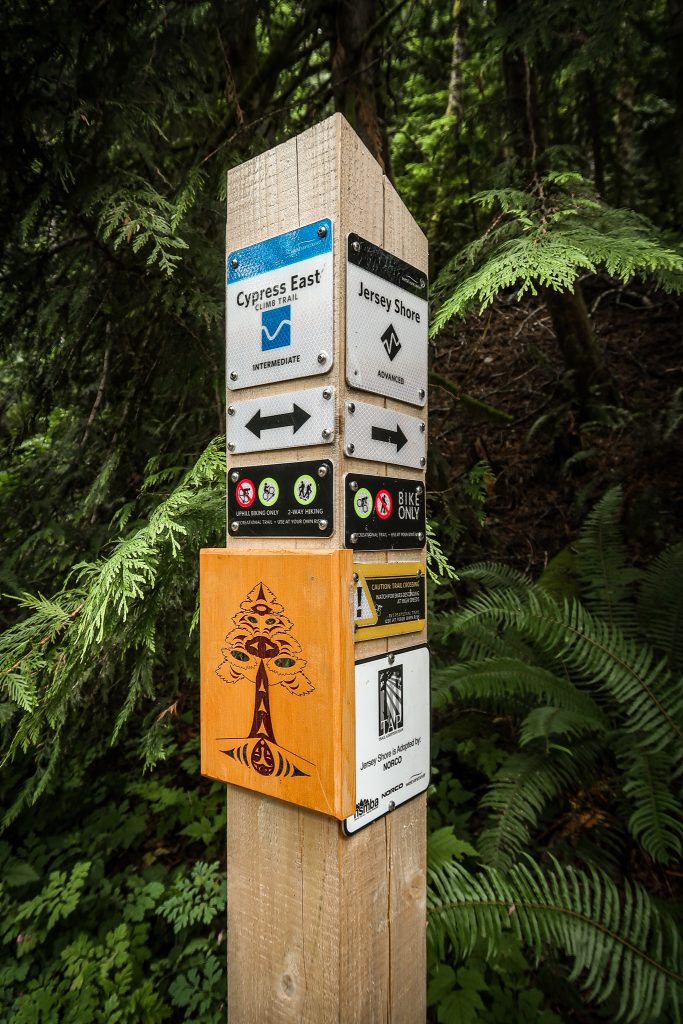
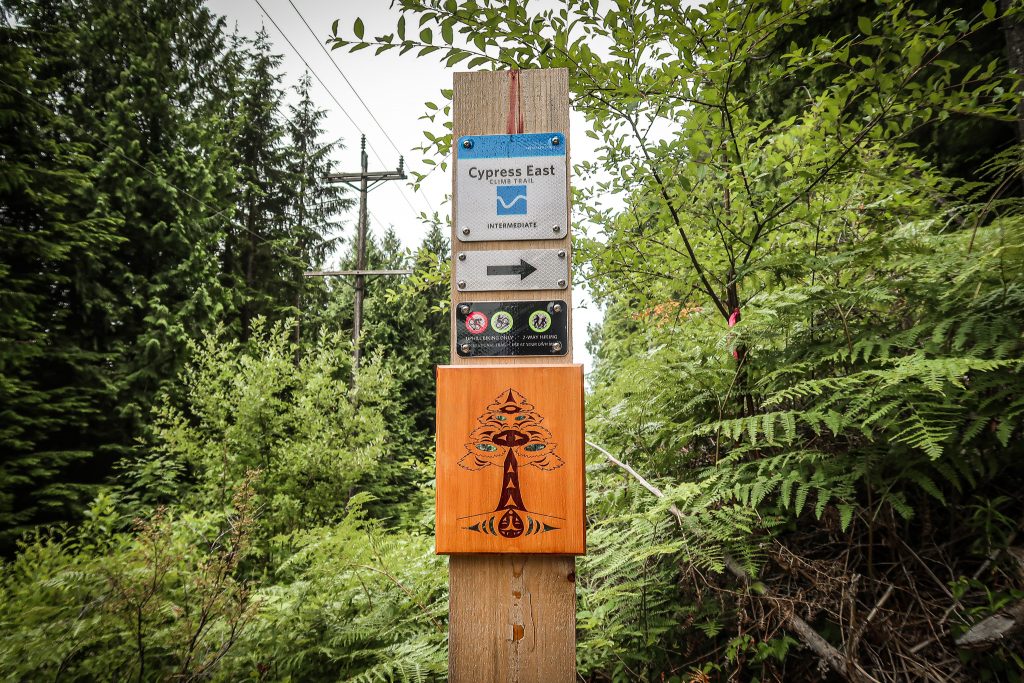
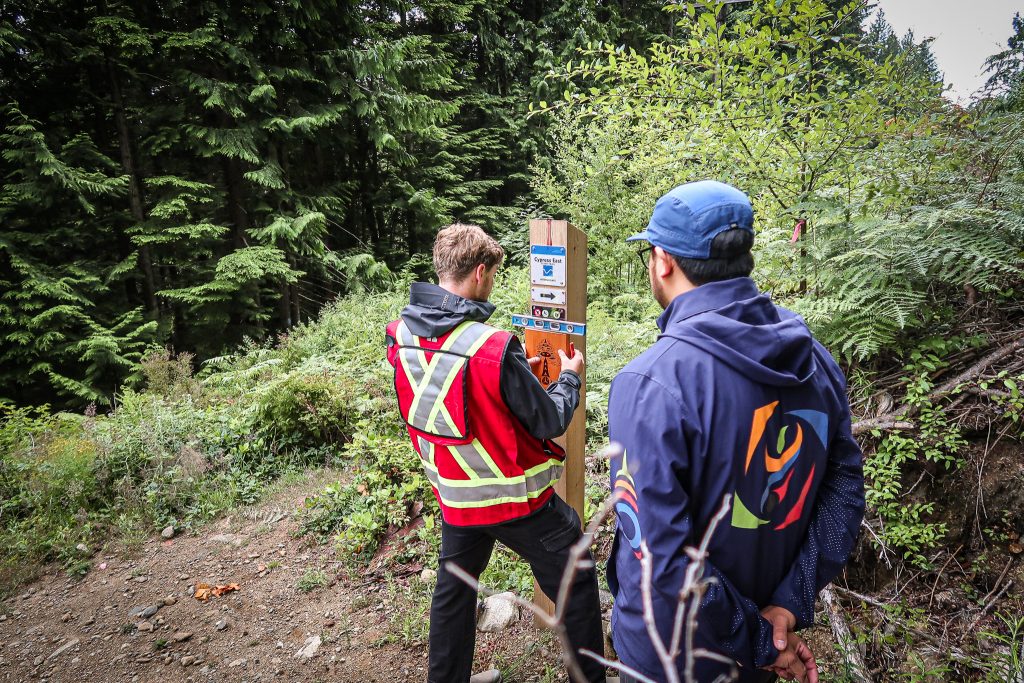
The NSMBA is excited to share a new permanent public art installation on the Cypress East Climb Trail. These beautiful cedar plaques are a creation by Squamish artist Calvin Kieran Bruce Charlie-Dawson. This Indigenous Art Trail Enhancement project was funded through grants from the District of West Vancouver Community Grants, West Vancouver Foundation and British Properties with support from the DWV parks department, and in collaboration with Squamish Nation Language & Cultural Affairs. We extend our gratitude and appreciation to Calvin, Adrienne, and Lacey from the Squamish Nation for their work bringing this project to life. Learn more about this art project:
Honouring the Root People – by Calvin Kieran Bruce Charlie-Dawson
The Design I have created is a depiction of a cedar tree (Xepayay), the most sacred and established resource for the Squamish people and many other nations across the Pacific Northwest. It is from the cedar tree we build our homes and canoes and ceremonial relics, the inner bark was used to make anything from baskets to hats and other items of clothing, a skilled weaver and processor of cedar could even make it soft enough to be used as a diaper for infants and make baskets that were so water tight that water could be boiled inside of it. Even the boughs were used as a form of physical and spiritual cleansing, ridding the mind, body and soul of impurities. When in ceremony, one of the key aspects is paying respects and utilizing the four directions and entities of the earth: The four legged creatures that walk upon this earth, the creatures that fly high in the sky, the creatures that swim in the sea and lastly the creatures that root into the earth (plants and trees, etc.).
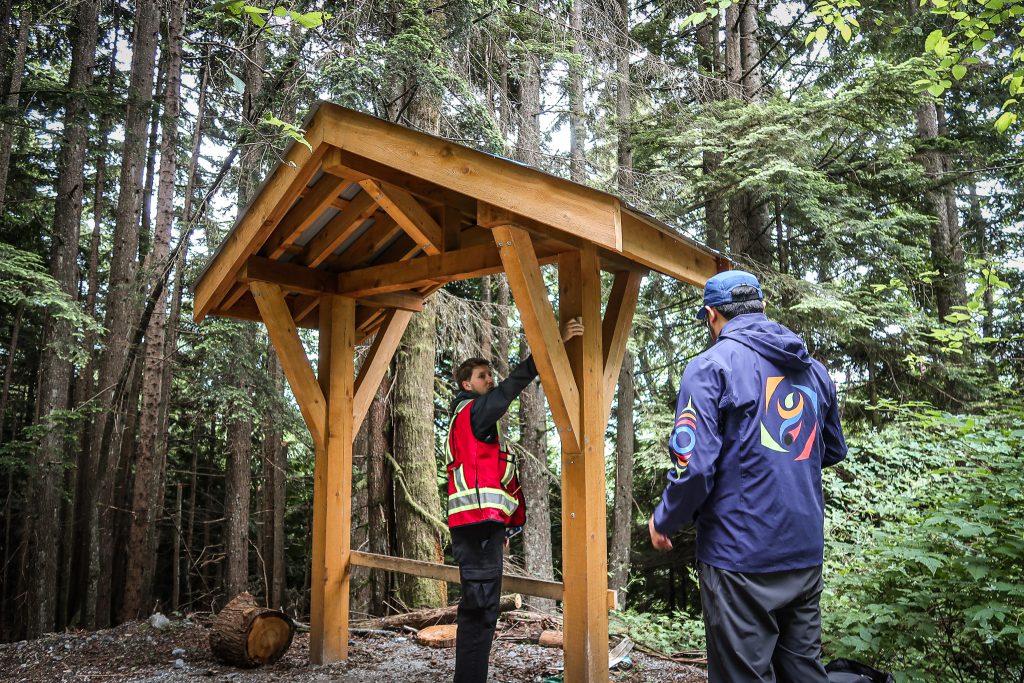
I chose the cedar tree as the staple of this project for its importance to the Squamish people since time immemorial and how we continue to use this resource today. Cypress mountain was and still is utilized as an area for harvesting red and yellow cedar bark. Along the climb trail and all throughout Cypress Park, culturally modified trees can still be found up and down the mountain side, reminders for the future generations to harvest sustainability. Trees such as these are archeological evidence of the Squamish Nation’s presence in this area and are vital to upholding the Squamish Nation’s heritage to the land which we have stewarded since the beginning of time.
The design itself was laser engraved into cedar planks displayed at the entrance and exit of the trail as well as throughout the trail on wooden trail markers as reminders to all who use these trails to respect nature and pay respects to the root people as they still to this day provide for mankind and to respect all walks of this earth as we live in a delicately balanced ecosystem and must be held to a certain standard as it has existed upon this world far longer than we as humans have.
Biography:
Ts’kanchtn (Calvin Kieran Bruce Charlie-Dawson) was born to Adrienne R. Charlie and Calvin M. Dawson on March 9th 1998, his lineage is comprised of the Squamish, Sto:lo and Kwakwaka’wakw nations. Calvin is a long time cultural ambassador through all channels of his bloodlines. He has been dancing with Le la la Dance group since 2009. Calvin also dances with Tsatsu Stalkaya and Ta na wa kawstem. Throughout the years Calvin has developed an affinity for the traditional art of his people and continues to learn the stylings and techniques of first nations art from experienced artists before him, such as drawing, painting, carving and canoe carving.
Most recently he has been learning his language through SFU Language Proficiency Program, during his course load he was approached to translate traditional animals and he was a part of a project designing a canoe for the RCMP (Sma7kwa) through partnership with Squamish Nation. He is also in partnership through FNHA, teaching youth basics to art form at a youth conference hosted on the Sumas FIrst Nations. Another contribution Calvin has made is the logo for the Kidney fountain, a formline design depicting a pair of kidneys. Over the summer he was hired as a language intern for the Tsleil-waututh nation where he continued to learn and teach the Squamish language alongside his language peers. One of his biggest dreams is to be a modern day warrior, protecting his traditional lands and rights through art, language and culture, some of the pillars of modern first nations culture